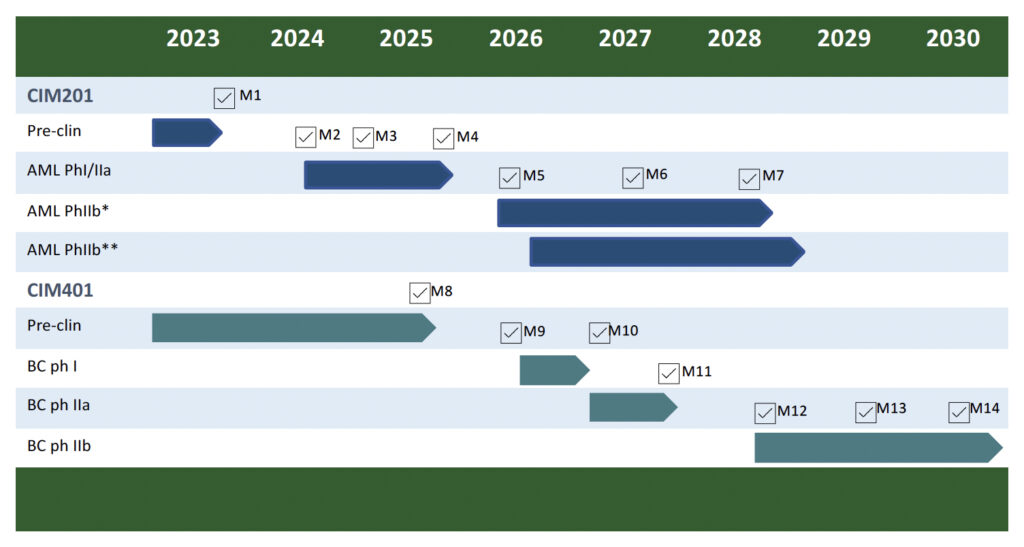
PIPELINE

Adoptive NK cell therapy
CiMaas stands as a frontrunner in the field of NK cell therapies, committed to transforming cancer treatment by offering innovative solutions and strategic partnerships within the domain of immuno-oncology. Our vision is not merely to treat cancer but to provide cures that are safer, more effective, and markedly improve patients’ quality of life. This will drive an excellent business opportunity and market position. Our NK cell product (NK-Xpand) functions as a proprietary platform for treatment of many types of cancer. Currently, we are capable of expanding NK cells 5.000-10.000 fold in 12 days with our proprietary technology using the in house generated feeder cells. The cytotoxicity of these cells is very high, even after a freeze/thaw cycle.
CIM101
CiMaas will start clinically by conducting a Phase I study in Acute Myeloid Leukemia, as this malignancy serves as the most compelling and appropriate context for showcasing the potential of the CiMaas’ NK-Xpand platform. AML is the most appropriate disease to start with since NK cells are especially effective against this disease as has been observed by us and others. The prognosis for patients with AML is a complex interplay of factors, including age, co-morbidities, and specific chromosomal/molecular abnormalities in the malignant cells. The determination of an optimal treatment plan hinges on assessing these risk profiles. Despite advances in medical interventions, AML remains a largely incurable disease for most patients, particularly those in the elderly population (aged >60), where survival rates are dishearteningly low (less than 25% exhibit a 5-year survival rate). Hence, there is an urgent and compelling need for improvement, and this is where adoptive NK cell treatment comes into play.
CIM102
The incidence of breast cancer in Europe, with rates ranging from 95 to 100 per 100,000 individuals, closely mirrors the situation in the United States, where it stands at 90 per 100,000. This translates to an estimated 300,000 new cases of breast cancer in Europe alone. On a global scale, the total number of new cases is a staggering 2,300,000.
We explore the value of NK cells in breast cancer. Our initial intrigue regarding NK cells stemmed from a notable discovery: when we subjected mice to a donor bone marrow transplantation (BMT), it became evident that the mice were effectively cured through the intervention of donor NK cells, rather than donor T cells.
As our NK cells also highly and consistently express CD16, the ligand to bind to the Fc tail of antibodies, they also kill cancer cells better in the presence of an antibody. This gives CiMaas the opportunity to combine antibodies with donor derived NK cells to optimize clinical responses. In CIM102 we combine the NK-Xpand NK cells with the anti-HER2 antibody trastuzumab.
CIM103
In CIM103, metastatic breast cancer patients will be treated with NK-Xpand NK cells and an anti-TROP2 antibody.
CIM104
Pancreatic cancer represents one of the most pressing unmet medical needs in oncology today. The incidence of pancreatic cancer is estimated at 6–10 cases per 100,000 people, translating into approximately 86,000 new cases annually across the EU, USA, and Japan (2022 figures). With demographic trends pointing to an aging population, and a median age at diagnosis of 70 years, this burden is expected to increase in the coming decades. Importantly, pancreatic cancer has one of the lowest survival rates of all major cancers, with a 5-year survival rate below 10%, and closer to 5–7% when all stages are combined. This stark mortality profile positions pancreatic cancer as a critical area for new therapeutic developments.
Defined as malignant tumors originating in the pancreas, this disease is dominated by pancreatic ductal adenocarcinoma (PDAC), which accounts for 90–95% of all cases. Despite advances in detection and treatment across many cancer types, pancreatic cancer remains a therapeutic area with very limited progress, underscoring both the urgency and opportunity for innovation.
CiMaas has the opportunity to combine antibodies against molecules highly expressed in PDAC with donor derived NK cells aiming to optimize clinical responses.
Adoptive CAR-NK cell therapy
To further improve NK cell activity, CiMaas develops Chimeric Antigen Receptor (CAR)-NK cells for solid tumors. Toxicity of CAR-NK cells is expected to be lower than CAR-T cells. The CARs are directed against tumor-specific underglycosylated proteins. CAR’s can be incorporated in safe harbor loci or in checkpoints. In the latter the negative regulator is knocked out by CRISPR/Cas9 technology creating a synergistic mechanism.
The research work is performed in close collaboration with our group at Maastricht University.
CIM105
We have generated HER2-CAR NK cells and MUC1-CAR NK cells that are more cytotoxic in comparison to identical numbers of unmodified NK cells.
CIM106
We have generated NKG2A knock out NK cells that are more cytotoxic in vitro and in vivo than unmodified NK cells.
CIM107
We are generating TIGIT knock out NK cells.
CIM108
HER2-CAR NK cells and MUC1-CAR NK cells will be generated by incorporating the CAR in the NKG2A locus using CRISPR/Cas9 technology in combination with harmless adeno associated viruses for high gene transduction.
CIM109
HER2-CAR NK cells and MUC1-CAR NK cells will be generated by incorporating the CAR in the TIGIT locus.
CIM201: Feeder cells for NK cell expansion
CiMaas can provide the F012 Feeder cell to interested parties seeking rapid NK cell expansion from various sources under licensing conditions. The F012 clone is manufactured in a B-grade cleanroom under GMP conditions and underwent comprehensive characterization to ensure it is free from adventitious viruses, mycoplasma, and other contaminants, making it suitable for clinical NK cell manufacturing applications.
F012 is available as irradiated product, as well as a non-irradiated (patented) product that has been treated differently. Both treatments results in identical expansion rates of NK cells and are completely absent in the final NK cell product.
Please contact us for potential collaborations.